

No Condemnation. Scatter Widely.
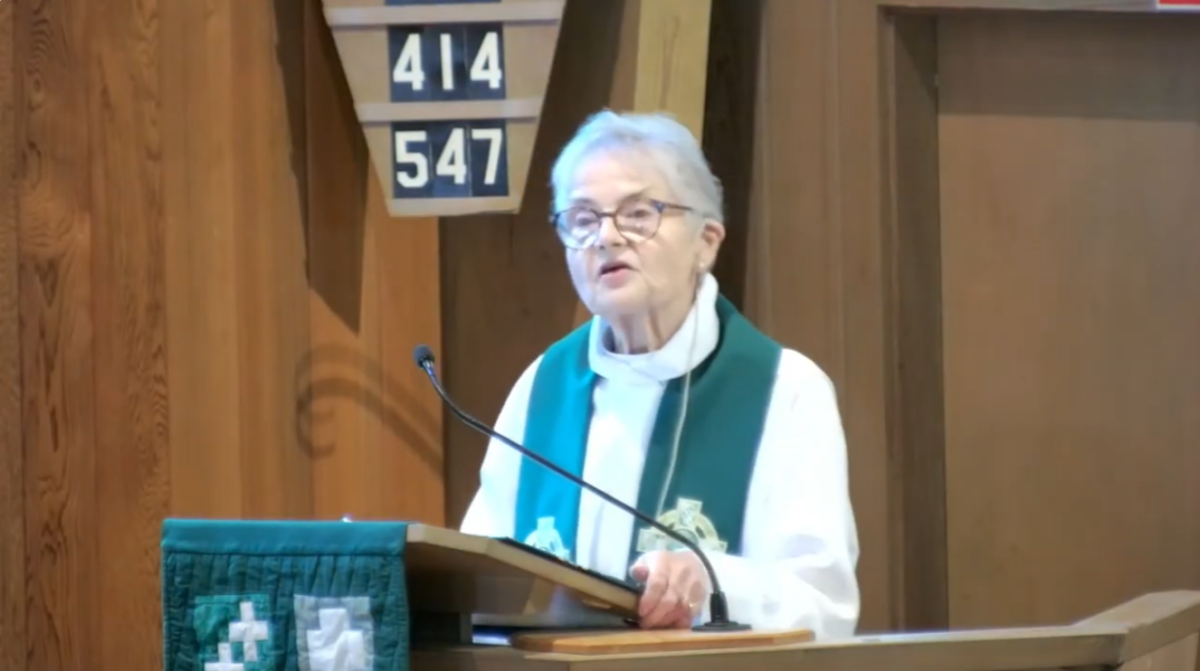
Does it have any hard words? I’m thinking Karen Danielson may have heard this question in her career of scheduling lectors here at Holy Trinity.
On the day of Pentecost, for example, I bet many of us sit comfortably in the pew thinking, “Glad it isn’t me,” as the lector goes on about the “‘Parthians, Medes, Elamites, and residents of Mesopotamia, Judea and Cappadocia, Pontus and Asia, Phrygia and Pamphylia, Egypt and the parts Libya belonging to Cyrene, and visitors from Rome, both Jews and proselytes, Cretans and Arabs’” – the miracle of all the world’s people hearing of God’s deeds of power in their own languages. (Acts 2:9-11)
We know this: for any number of reasons, the Bible is not easy. Have you noticed, for example, over the past few weeks, how difficult it is to understand the chapters of Romans that have been assigned as our second lessons? Paul wrote letters to the Christian communities he founded, and in these letters, the sentences can be long and confusing. HIs writing reflects a rhetorical style unfamiliar to us today. His arguments are convoluted and difficult. He addresses a topic, then returns to it later. Some of Paul’s words may seem familiar on the surface, but then they are used in ways we don’t expect. In reading aloud, you must be very careful about inflection, or Paul’s meaning is easily lost by your hearers.
Let me draw your attention to our lesson today from Romans, chapter 8. Now you may have heard his words, just a few minutes ago, but perhaps the reading is already out of your mind, because face it, Paul here is so very Paul! He talks about “the law of the Spirit of life” and “the law of sin and of death.” What??? He talks about the body; he talks about “those who live according to the flesh” and “those who live according to the Spirit.” You’re right – Paul has specific understandings of those terms that are not how we may commonly understand them.
Paul’s writing always needs an inquiring mind . . . unpacking . . . and explanation. But in Paul’s words to us this morning, there is one sentence that is crystal clear. No ambiguity. No rhetorical flourishes that confuse the modern-day hearer. Paul says it straight out: “Therefore there is now no condemnation for those who are in Christ Jesus.”
If we don’t understand one other thing in Paul’s letter to the Romans, this is one sentence we are meant to hear – maybe that is why Paul puts it so definitively, in such assertive language. There is no condemnation for those in Christ Jesus. No condemnation – none. And this is in the present tense. This is not at some point in the future. Right now, there is no condemnation.
For whom? For you, the people in Jesus Christ.
This is the good news, the gospel, stated as straight-out and clearly and simply as it can ever be put. “Therefore there is now no condemnation for those who are in Christ Jesus.”
Whenever you hear the word “therefore” in Paul’s writing, you know you’ve reached some kind of turning point. Today Paul has come to the end of a long theological argument. We heard part of that argument last Sunday when our readings included Romans, chapter 7. In that passage Paul laments the dilemma: “For the desire to do the good lies close at hand, but not the ability. For I do not do the good I want, but the evil I do not want is what I do.” (Rom. 7:18-19) Paul reminds us that he, like all of us, is captive to the power of Sin, Sin with capital “S.” We live turned in on ourselves, and turned away from God. This is what Paul calls life “according to the flesh.” He’s not condemning our bodies or our bodily existence, as you might think, rather he’s drawing our attention to lives that are focused anywhere else but God.
In contrast to the life of the flesh, Paul speaks of life “in the Spirit.” This is a life turned to God, a life lived in accordance with God’s will. Paul tells us, “To set the mind on the flesh is death, but to set the mind on the Spirit is life and peace.”
Well, we want to set our mind on the Spirit . . . but how? How exactly do we do that? That’s what Paul makes clear today. It’s not something we do! Paul writes, “For the law of the Spirit of life in Christ Jesus has set you free from the law of sin and death. For God has done what the law, weakened by the flesh, could not do: by sending his own Son . . . he condemned sin in the flesh.” That’s a complicated way of saying what Paul has already said: “There is now no condemnation for those who are in Christ Jesus.”
No condemnation. Not one bit. And were we able to hear this text in the original Greek, Paul’s point would be even clearer. For in the original language, the word “no” is the very first word in the sentence – the grammatical place of emphasis.
Understand this, if you understand nothing else about this letter to the Romans. You have been freed – from sin, from death, from condemnation, from guilt, anxiety, fear, from shame or blame, from insecurity, from inadequacy – from what you have done, or what you have left undone. God is not angry with you. God does not hold grudges. Saint Peter is not standing at heaven’s gate, like in so many comic strips, totaling up your wrongs and preparing to send you wherever because you didn’t “make the grade.”
The Lord God has reached out to you, to us, in mercy, grace, and love. You are now free, freed to love God, serve God, serve the people around you. This is the gospel, the good news, of Jesus Christ.
Okay. Let’s switch gears here, and turn to seeds – to today’s gospel!
We find ourselves in Matthew again; today we hear from Jesus’ third missionary discourse, the third body of Jesus’ teaching in this gospel. This third discourse is different from the first and second missionary discourses that we’ve read over the past several weeks. In this third discourse Jesus tells seven parables to teach us about God and God’s reign. Parables are stories, of course, brief stories from everyday living or nature, but they are meant to take up room in our heads, tease us, confuse us, make us wonder and rethink.
Today we have the sower; he put his hand in that seed sack and started flinging, and the seed went everywhere. Some seed fell on the sidewalk, and the sparrows and the pigeons gobbled it up and invited all their friends. You would have thought, then, that the sower would exercise a little more care. But still, he tossed it out – and more fell among the rocks, then among the thorns. Finally, some did fall on good soil, and there was a yield.
This is a parable that stays in my head – it bothers me, because what I’m learning these days as the official gardener in my house, is that lawn care costs money. Maintaining a yard is expensive. This sower threw the seed out and when it landed on the sidewalk he didn’t worry; when it ended up in the rocks, he didn’t care. With so little regard for preparation of the dirt or where the seeds were landing, he just as well may have been tossing out coins. But he kept going, trusting that there would be a harvest, and indeed it seems there was.
I have to ask – why in the world wasn’t he more cautious? Exacting? Why so wasteful and inefficient? Seeds cost money. Labor is money.
But isn’t Jesus saying here that God will expend endless resources and endless energy to gather us in, to invite us to sprout and grow in the Spirit? God is prodigal, liberal, and endlessly free-wheeling when it comes to brokering relationships – even to the point of Jesus dying on a cross – for us!
Remember Paul? “There is now no condemnation for those who are in Christ Jesus.”
I suspect we are not that giving, or prodigal. We do not buy buckets of seed and just fling it out. We carefully prep our small plots of ground and buy one bag of topsoil and the economy package of grass seed. We’re smart when we sow – we are careful, oh so careful, of resources (because aren’t they limited) and also careful of ourselves. Because aren’t sowers limited too?
But are they really? Are they really?
Because our readings today suggest not. God, it appears, is endlessly giving, wasteful even, in sharing love, grace, mercy, and resources with us. Our God is not a God of scarcity. And our God invites us to pay it forward. God is so generous with us. How can we do otherwise?
When I was up in Maine last week, we stopped for ice cream at a place called the “Sugar Shack.” On the wall of this place was a string with clothespins holding receipts. If you needed help paying for your food, you were invited to simply unclip a receipt and take it to the cash register! Some generous person who had come before you had paid towards your meal.
God has blessed this congregation with faithful people over many years. God has blessed us with a building and resources. I do not think God intended us to hold those things tight for some rainy day sometime in the future. Because our faith invites trust, trust that God will see our needs and always provide, now and in the future.
Today I think our munificent God – our “fling it out” sower – is inviting us to open our hearts and our minds. To use the resources entrusted to us – for ministry now. Ministry in this place, at this time, in this world, where loving, compassionate, “no condemnation” ministry is so desperately needed.
Jesus says, fling out the seed. Not a seed here or a seed there, making sure each one lands carefully in the right furrow. God’s concern, it appears, is to get it out there! Because if it’s not out there, a seed remains just a seed, and what is the good of that?
God is so lavish. God gives so abundantly.. God makes green and verdant what is dry or hopeless. And I do believe God calls us to do the same. Today God invites us to become sowers of abandon. To do bold ministry – life-saving ministry in the name of Jesus. God’s unfolding generosity in our readings today challenges us to think big. To pray big. To act big. To take chances. To plant where we have never planted before. To spread the seeds widely and look for the sprouts. To use the resources entrusted to us, and to trust in God’s provision for the future.
It is perhaps no coincidence that Holy Trinity’s Season of Discernment and Mission Revitalization has come at this particular time, after a long, dreadful season of covid. It’s no coincidence that this process is birthed now, when our country seems so at odds and divided, group against group, and when generosity seems to be a lost practice.
In our baptisms, the Lord God has reached out to us, in mercy, grace, and love. We have been freed from sin and condemnation to love God, serve God, serve God’s world. This is the gospel, the good news, of Jesus Christ.
So let’s fling that seed. Amen.