
A Cup of Cold Water
Aren’t there times in your life when you have asked the question, “What’s the point?”
A long time ago, I played the clarinet. One year in college I played in an orchestra; I sat one seat below a fellow who was quite a good musician. He played in the orchestra as an extracurricular activity; he was not formally studying music. It turned out, however, that his father was a professional musician and his brother was studying to be a professional musician. His family had very high expectations in this area, and this young man had assimilated these expectations – and clearly thought he himself had not met them. He made the remark one day, “What’s the point of playing if you’re not going to be the best?” By that he meant a top-grade musician.
Well, despite the fact we were having a blast in this orchestra (to say nothing of the fact of going to the pub after rehearsals, because this was in England), I have to admit, at the time, I sort of agreed with this guy! At that mature point in my life, I often thought – what was the point of the practice and rehearsals and effort if you can never be Yo Yo Ma or Louis Armstrong? Although I was having fun, I’m not sure I truly appreciated the satisfaction and enjoyment playing or singing can bring – for oneself and others. And after all, very, very few of us will ever be the caliber of those top-tier musicians.
But, don’t we think this way sometimes? “What’s the point?” What’s the point of crime-busting, a police officer might say, there’s just going to be another robbery tomorrow. What’s the point of cleaning a room, says the parent, it’s going to be a mess again as soon as the kids get home. What’s the point of one child escaping poverty, the social worker points out, there are a million more caught in a web of poor educational opportunities and drugs and all the rest. We look around at our world and we see so much division, so much hurt, so much pain. We see war. People dying in Africa from cuts in food and medical shipments. People deported back to the place they struggled to leave. Peoples’ lives turned upside down by wildfire or floods or tornados.
What’s the point? We put one finger in the dyke, but at a million other points the water is rising above our heads and very quickly.
Maybe we ask this same question in the church. How can we possibly make the kingdom of God visible among all the problems of this world? What’s the point of ministry – when all the “isms” swamp us – racism, sexism, gender hatred, etc., etc. What’s the point when our ability to have a reasonable exchange of viewpoints seems . . . so impossible? What’s the point when cruelty, or at the very least indifference, seems to outweigh kindness? What can we do? We as individuals; we as a small congregation; we, as the ELCA; we even of the Lutheran World Federation? What can we do against such odds? The enormity overwhelms us.
Today, we come to the end of the Missionary Discourse in Matthew’s gospel. Jesus, over the past weeks, has been speaking to his apostles, the twelve who are to be sent out to proclaim the good news, ‘“The kingdom of heaven has come near.’” Over several Sundays, Jesus’ words have contained promise – but also warnings. Jesus’ followers are “‘like sheep [sent] into the midst of wolves.’” They will be flogged, and dragged before governors and kings. Brother will betray brother. One’s foes will be members of one’s own household. Your first priority, Jesus told his followers, must be me – not your family, not anything else.
To say nothing of the fact that Jesus called his disciples to large and demanding tasks: heal the sick, raise the dead, preach to strangers, cast out demons. Doing what Jesus asks will not be easy; it may not be what we want to do. It will involve sacrifice.
I just wonder, if hearing the challenge of Jesus’ words, how many potential disciples thought to themselves, “What’s the use?”
What is the point? We look at ourselves and we doubt. We know we don’t have the spirituality of Francis of Assisi, the self-giving of Mother Theresa, the theological insights of Martin Luther, or the commitment to justice of Archbishop Oscar Romero. Those hard sayings of our Lord confront us – love your enemies and sell everything you have and follow me, and turn the other cheek. We feel weary after a Church Council meeting, let alone persecution. We have very real doubts about our demon-casting abilities.
Of course, we understand clearly that Christianity is not easily lived out in our La-Z-Boy chair. But, still . . . !
Today, Jesus challenges us out of this complacency, or should we call it defeatism? Today Jesus tells us that even the simplest, most elemental acts of kindness and charity are important in God’s redemptive plan.
“‘Whoever welcomes you welcomes me, and whoever welcomes me welcomes the one who sent me. Whoever welcomes a prophet . . . will receive a prophet’s reward . . . whoever welcomes a righteous person . . . will receive the reward of the righteous . . . whoever gives even a cup of cold water to one of these little ones . . . truly I tell you, none of these will lose their reward.’”
Can giving a cup of water possibly compare to casting out demons or enduring persecution for the faith or working amongst the dying in Kolkata (what we used to call Calcutta)? Apparently Jesus does not weigh acts of faith or hospitality or kindness, finding some more weighty and worthy than others.
How we admire Mother Theresa, and we think, I can never do that. Maybe true. But . . . it is equally true that Jesus calls us to hospitality right here in North Easton – to reach out and welcome with that cup of cold water – and it seems that Jesus values this service equally as much. Jesus doesn’t ask us to be the first, or the best. Jesus does ask us to be faithful.
When I was in the parish, Baltimore was one of the places I would go to visit people who were hospitalized. One time the person I went to see had been transferred from one building to an associated nursing facility. I drove all around this large complex trying to find the right building. Finally, I saw a woman, obviously a hospital employee, who was heading out to the parking lot, and I rolled down the window and asked for directions. Well, she didn’t know where this building was either.
Now, most people at the end of their shift would probably say, “I don’t know” and continue to their car. I was absolutely astounded when she trudged back into the building and hailed a security guard who was able to tell me where to go. Did she endure persecution? No. Did she fight demons – no, other than her own tired feet. Was this an act of hospitality and kindness? Absolutely. “‘Whoever welcomes you welcomes me, and whoever welcomes me welcomes the one who sent me.’”
I still remember that incident, and that woman, all these years later.
The beauty – and the surprise – of our message today, at the end of Jesus’ challenging Missionary Discourse, is its very simplicity – its emphasis on the simple, the do-able. As William Barclay reminds us, the Church of God needs its saints, the martyrs that have been such examples of faithfulness through the centuries, its great preachers and theologians – the so-called giants of the faith – and they are giants. But more and more, I have come to appreciate the ordinary folks who, day by day, hour by hour, live out their faith. Taking someone to the doctor. Taking lunch to a sick neighbor. Stopping to help with a flat tire. Speaking out when a remark is made against races or groups of people. Listening to a friend who needs to talk when you have a million other things to do. Bringing cookies for Father Bill’s month after month. Offering “‘ cup of cold water’” – being that hospitable, welcoming person, in the name of Jesus – can take many guises.
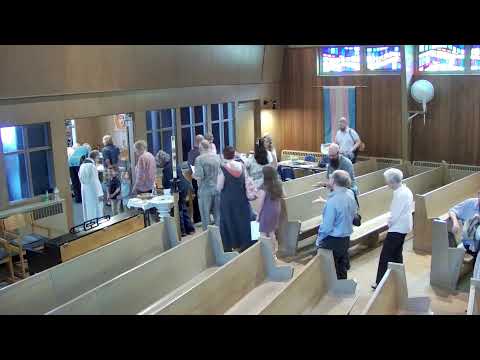
This morning we have a baptism! We are delighted to welcome little Robert into the community of Holy Trinity Lutheran Church and the community of all God’s people of every time and place! A constant theme of the Lutheran reformers is that we are called in our baptisms. We each have different gifts, and we are each called to different tasks. But whatever our calling, we are called as Christians to do it to the glory of God and to the best of our ability. Philip Melanchthon, Martin Luther’s colleague, wrote about the taking of monastic vows, which were, in his day, thought to be higher on the spiritual ladder than ordinary human pursuits. He said this: “The monastic life will be no more a state of perfection than the life of a farmer or an artisan. These, too, are states for acquiring perfection . . . . that is, growth in the fear of God, in faith, in the love of their neighbor . . . .”
In living a Christian life, we could easily say, “What’s the point? But I don’t believe Jesus is weighing Mother Theresa in one hand and ourselves in the other. And haven’t we learned that mathematics in the kingdom of God is far different from what we learned in school? The smallest act of hospitality and kindness can grow like that tiny mustard seed. The smallest act is great in the kingdom of God. God makes it so.
So what about that cold water? God wants it; Jesus demands it. The recipient needs it; we provide it. That simple glass of water . . . brings us all, together, into God’s kingdom.