
Live Boldly
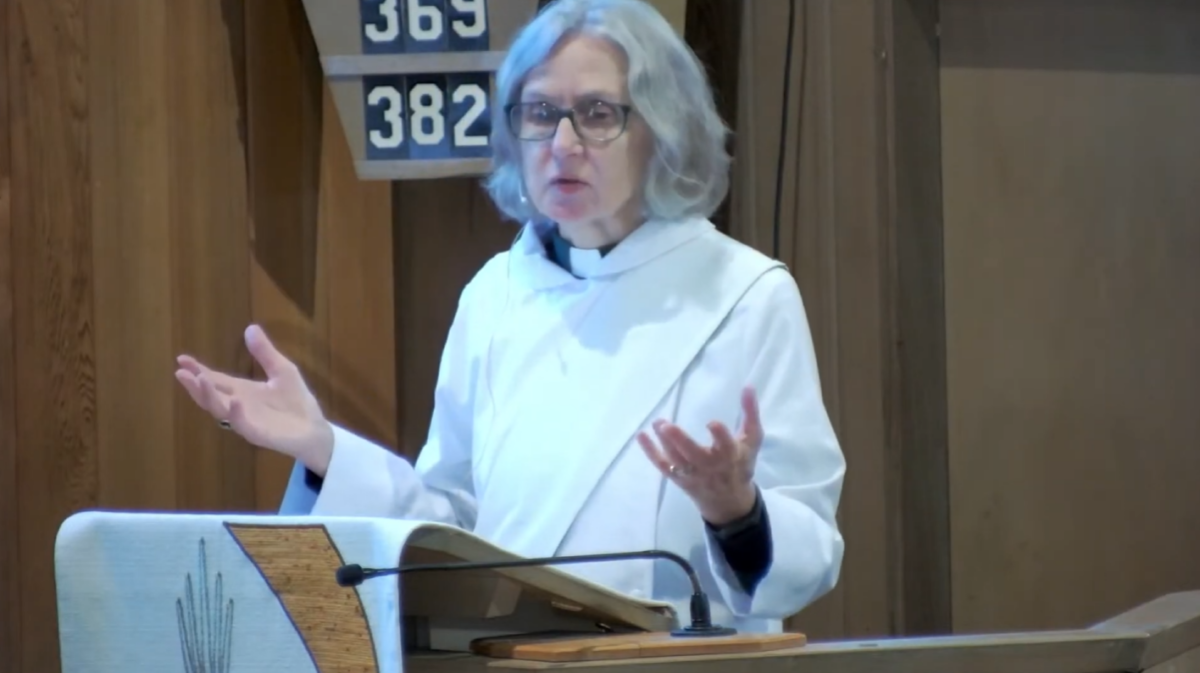
Alleluia! Christ is risen!
Christ is risen indeed! Alleluia!
So, what do you think? Where was he? Where was Thomas when the other disciples were gathered together, in the evening on that day, the first day of the week?
This is the evening, of course, of the resurrection of Jesus. Early in the morning on that day, Mary Magdalene; Joanna; Mary, the mother of James; and the other women had gone to the tomb where the crucified body of Jesus had been lain; to anoint Jesus’ body for a proper burial. When they got to the tomb, the tomb was empty. Jesus was not there.
The women ran to tell the male disciples; some of them returned to the tomb and saw for themselves that it was empty. What had happened to Jesus’ body? The men did not know.
In their bewilderment and grief, the disciples did what people frequently do when a loved one has died – they gathered together in a familiar place (perhaps the same room where they ate the Passover meal with Jesus 3 nights earlier). This time the disciples met behind locked doors, fearful that they, like Jesus, might be persecuted by the religious authorities.
Where was Thomas? Why was he not there, hiding with the other disciples, fearing for his life?
- Perhaps he was taking a long walk through the streets of Jerusalem and the surrounding area, trying to clear his cluttered head.
- It’s possible that he left Jerusalem, crossed the Kidron Valley, and returned to the Garden of Gethsemane on the Mount of Olives, to pray and lament in the place where Jesus had been arrested.
- Or maybe he was so worn out from the trauma and grief of watching his friend suffer and die on the cross that he had gone back to wherever he was staying in Jerusalem, huddled under his favorite blankie, and fallen into a deep sleep.
- Then, again, he could have been with a grieving relative or friend, consoling them with his presence and prayers.
Wherever he was, whatever he was doing, that night Thomas was not with the disciples, hiding behind closed doors in fear. He was someplace else; going about his business; living his life; doing what he needed to do.
He was not there when Jesus came and stood among the disciples and said to them “Peace be with you.” and showed them the wounds on his hands and feet. Later, when the disciples tell Thomas they have seen the Lord, he
responds by saying he wants to see Jesus’ wounds for himself; only then will he believe what the disciples said was true.
A week later, Thomas has his opportunity. He is with the other disciples, in the same locked room, when Jesus comes and stands among them and says “Peace be with you.” Then Jesus offers his wounds for Thomas to see and touch (note that the gospel does not say that Thomas actually touched the wounds). There’s no need to doubt, Jesus says, only believe. Which Thomas does (more about that in a minute).
Thomas’ insistence on needing to see Jesus’ wounds for himself in order to believe the words of the disciple has led, through the centuries, to Thomas being labeled as “doubting Thomas”.
Google that phrase (i.e., look it up on line) and you will find that “A doubting Thomas is a skeptic who refuses to believe without direct personal experience – a reference to the Gospel of John‘s depiction of the Apostle Thomas, who, in John’s account, refused to believe the resurrected Jesus had appeared to the ten other apostles until he could see and feel Jesus’s crucifixion wounds.”, according to Wikipedia.
To this day, Thomas is still best known for that one time he spoke up and clearly expressed his need to see and touch the risen Jesus; that is, to experience Jesus’ resurrection in the same way as the other disciples had.
There’s so much more to Thomas’ story and his life as disciple of Jesus.
Thomas, as one of the original 12 disciples, spent 3 years with Jesus –
watching him; listening to hm; learning from him; praying with him; receiving on the job training in how to share the good news with other people from the Master himself.
Today’s story is not the first time that Thomas has spoken up and clearly expressed what was on his mind. Earlier in the gospel of John, Jesus’ friend, Lazarus died, and Jesus wanted to travel to Judea to be with the family. His disciples were afraid to go there because they knew the religious authorities in Judea were trying to kill Jesus. It was Thomas who boldly said to the disciples “Let us also go, that we may die with him.” (John 11:7-16).
Then, on the night Jesus was arrested, Jesus gathered with his disciples around the table one last time and told them that he was going to prepare a place for them in his Father’s house (where there are many dwelling places); and they knew the way to the place he was going. It was Thomas who boldly asked the question that perhaps all of the disciples were wondering – “Lord, we do not know where you are going. How can we know the way?” (John 14:1-5).
Finally, in today’s gospel reading, after seeing Jesus’ wounds, Thomas boldly declares “My Lord and my God!”, making him the first disciple to recognize that this risen Jesus is the revelation of God’s Word that has been in the world with God from the beginning of creation (John 1:1).
Clearly, Thomas was a person of deep faith. He shows up before the risen Jesus – before God – as his full, authentic, quirky self. He does not hide from his questions or wonderings or doubts; he blurts out whatever’s on his mind, willing to engage in conversation and discernment; willing to change his point of view to more fully understand the truth of Jesus’ words.
Perhaps it is Thomas’ curiosity and willingness to ask questions (and listen to the answers) that deepens his relationship with Jesus and strengthens his faith. Perhaps that’s what gives him the courage to speak out boldly and share the good news of the resurrection of Jesus Christ for all people, even on the hardest days of his life.
(Footnote to Thomas’ story – Thomas eventually left Jerusalem and traveled to India, where he proclaimed the good news and established Christian community with the people there; he is considered the patron saint of India).
The story of Thomas is a good reminder to us of the danger of labeling people. If we only think of Thomas as “doubting Thomas”, we miss knowing the richness of his life as a witness to the risen Christ.
There is always more to a person than we can see on the surface.
Jesus accepted Thomas as the unique individual that he was; beloved by God and created in the image of God; a person standing before the risen Jesus, seeking healing and salvation for himself and for the people around him; willing to go out and boldly do the work that God had given him to do.
The good news for today is that Jesus accepts you as the unique individual that you are; in all of your quirkiness, you are beloved by God, created in God’s image, and embraced by God exactly as you are.
Rejoice in that good news! Stand before the risen Jesus; experience the healing and salvation that Jesus gives you and the people around you and the whole cosmos; be a witness to the risen Jesus; go out and boldly do the work God has given you to do.
Peace be with you.
Alleluia! Christ is risen!
Christ is risen indeed! Alleluia!