
Acting shrewdly and scattering the good news

If you are like me, after hearing this morning’s gospel reading, you might be scratching your head and wondering – what the heck is Jesus trying to teach his disciples – and us – through this story?
Is Jesus really telling us that we should use our wealth to make friends for ourselves through dishonest means? Probably not.
Or is he speaking with a bit of irony, perhaps bordering on sarcasm, in an attempt to get our attention and remind us that following him means we live our lives in ways that are different from how many people around us live? Could be.
Is Jesus offering us an example of subversive living? – that is, living in a way that disrupts current dominant thinking about economic systems and the desire to acquire wealth and power in favor of living in the kin-dom of God, a kin-dom rich with grace and mercy and love and justice for all people (not just the wealthy and powerful) where everyone has enough to live well? This gets my vote.
We can appreciate this story more fully when we understand the social and economic context in which it is told. In Jesus’ day (that is, in 1st century Palestine), wealthy men would purchase land from farmers who were struggling to pay taxes to the Roman Empire. The rich landowners would then demand payment from the farmers for the use of the land. Payments were collected by the manager (the steward) to be given to the landlord. It was common for the manager to impose a surcharge on the farmers (sort like a tariff) in addition to the high interest rates imposed by the landlord.
That was the economic system of the day. Based on a hierarchy of perceived worth and value of people – wealthy landowners first; then middle managers; then poor farmers – the rich got richer; the poor got poorer; and those in the middle did the best they could to make a living. There was no regard for justice; there was typically no consideration for sharing resources so that everyone had enough.
So, when the manager finds out he is about to lose his job because he (allegedly) was “squandering” the rich man’s property, the manager panicked. How was he going to support himself without his job? He gave it some thought and came up with a plan – he went to those who owed money to the landowner and discounted their debt (perhaps deducting the interest owed to the landowner or the surcharge the manager normally collected for himself). He acted “shrewdly”, Jesus said – to make an unjust economic situation more just and to create goodwill with his neighbors, changing his relationship with them so they would think more kindly of him when he was unemployed and needed their help to survive.
Two words in this story caught my attention this week – squandering and shrewdly. Both help reveal the deeper meaning of this story.
The word “squandering” can mean a couple different things – it can mean ‘to waste; to use recklessly or foolishly’; it can also mean ‘to scatter’. We come across this word used in both ways in two stories Jesus told his disciples.
In the story of the Prodigal Son (Luke 15:11-32), the younger son squanders the financial inheritance he receives from his father, spending the money foolishly until he has nothing left to live on and the older son squanders the emotional inheritance he receives from his father, recklessly throwing away his father’s love in his own bitterness toward his younger brother. Each son wastes something of value.
In the Parable of the Sower (Luke 8:4-8), “a sower went out to sow his seed….”; he squandered the seed, scattering it far and wide, on the path and on the rocks and in the thorns and in the good soil, where it grew a hundredfold. Some seed was wasted to produce a good crop.
Now the word “shrewdly”. To act shrewdly calls to mind a sense of deliberateness; weighing the pros and cons in a situation to come up with the best plan; it’s analytical and practical; maybe even calculating.
To act shrewdly can also mean to be wise and discerning; to ponder and pray and listen to the Holy Spirit for guidance in taking the next most faithful step toward building community so that God’s kin-dom will come now as in heaven. In the gospel of Matthew (10:16), as Jesus is preparing to send out his disciples to proclaim the gospel in the surrounding towns, he tells them to “be wise as serpents and innocent as doves”.
The manager in our gospel story this morning has shrewdly determined it was in his best interest to squander the rich man’s property and wealth – scattering it among the poor people so that he himself might have a better life. As a by product of this shrewdness and scattering, he has unintentionally contributed to the wellbeing of his neighbors and that is a good and righteous thing to do. Still, he has chosen to serve wealth and not God.
This is the subversive part of Jesus’ message for us today. We live in a time and a place where having wealth and power and authority is valued more highly than doing justice and loving kindness and walking humbly with your God (Micah 6:8).
To value wealth and power and authority above God is idolatry. We cannot serve God and wealth, Jesus tells us.
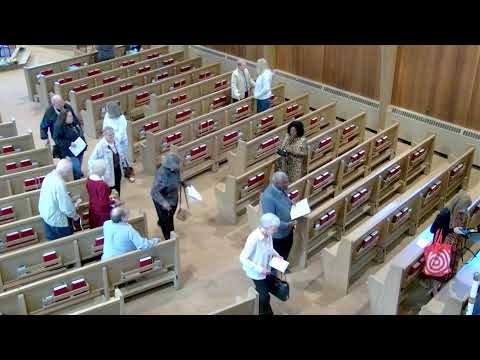
As people of God gathered together at Holy Trinity Lutheran Church; as people called by God to follow the example of Jesus, you also live in a time and a place – God’s time and place. In this time and place, doing justice and loving kindness and walking humbly with your God (Micah 6:8) is valued more highly than having wealth and power and authority. You are called to serve God.
As people of God gathered together, you have chosen to act shrewdly during this year of transition; to be wise and discerning in an intentional process of self-study and visioning; to listen to the voice of God as God leads you to the next most faithful step toward building community in this place; to listen to each other, with open, honest, and direct conversation, as you share your hopes and dreams and fears for the future.
All of this shrewd discernment has led to the completion of the Ministry Site Profile, a strong statement of faith and intent, outlining how Holy Trinity hopes to scatter the good news of Jesus Christ in the world with the support of a new minister. Thanks be to God for your good work.
Yet, Jesus tells us that we cannot serve God and wealth; we must make a choice between the two and act on that choice.
Like the manager in the gospel story today, we may wonder – What will we do?
Let’s be honest – Let’s tell the truth – Holy Trinity is a wealthy church; rich in faithful people and rich in material resources – property and mutual funds – that have accumulated over the years through the faithful stewardship of former and current members of this congregation. Some of these material resources are available to be used for building up the kin-dom of God now; to create a more just society for people who are homeless or food insecure or lonely; to share what Holy Trinity has been given so that all people may have enough.
I end this morning with these questions for you to ponder.
Is it time for the people of Holy Trinity to act shrewdly and discern (with open and honest and direct conversation) the next most faithful steps for the use of these material resources?
Is it time to consider how Holy Trinity can scatter (we might even say, squander) these material resources so that the good news of Jesus Christ can be shared in word and deed and bold action; with justice and mercy and grace and love for all people and all creation?
Jesus calls us to act shrewdly and scatter the good news.