
A Reign of Reconciliation

Today is the final Sunday of the church’s year. Today we mark Christ the King Sunday.
Sometimes I wonder if this whole image is problematic, a little anachronistic, for us as 21st century Americans. “We the people” do not have a king. We are proud of our revolutionary heritage, and those traditions of democracy that say that “we the people” select this country’s president. Armies of American soldiers have given their lives so that democratic government can be a possibility across the world. A few weeks ago, some 7 million people marched in “No King” rallies all over the country, to remind the current administration of the dangers of over-reach.
Much of what we’ve learned about Jesus during this past liturgical year does make us scratch our heads. A King? A baby born among animals and hay. His family dirt poor, in an occupied country. They were immigrants to Egypt. As an adult, this guy hung around with the sick, women, people from Samaria(!), tax collectors, riff-raff. He healed family members of occupation soldiers. He challenged those in power. Eventually he was tried as a political traitor and executed. People stole his clothes as he was dying and mocked him. They shouted, in irony, “‘King of the Jews,’” “‘the Messiah of God,’” “‘chosen one.’” They had a good laugh.
And yet . . . and yet . . . . “In him,” the author of Colossians tells us, “all things in heaven and on earth were created, things visible and invisible, whether thrones or dominions or rulers or powers.” “In him all things hold together.” “Through him God was pleased to reconcile to himself all things, whether on earth or in heaven.”
King Jesus is the one in whom “all the fullness of God was pleased to dwell.” He is “the firstborn of all creation,” and “the firstborn from the dead.” Lord of all, Alpha and Omega.
Today’s text from Colossians is like a freight train, phrase upon glorious phrase, one after the other, the word “all” repeated again and again, building to a crescendo so that we are left with no doubt that yes, this Jesus, this crucified one, is Lord of all. Lord of rulers and nations, things that are now and things that are to come. All things are redeemed by King Jesus. All things will be made new and whole and joyous in him. Jesus the King will bring forth that long-hoped-for “shalom,” that word in Hebrew that means wholeness, completeness, fullness, peace – all things coming together, on earth and in heaven.
This scripture tells us that on the cross, King Jesus fought a cosmic battle, and that the battle is won. Done, finished. Colossians trumpets this victory declaration – Jesus is King! The one who preached good news to the poor. Who, on the cross, opened his arms to all.
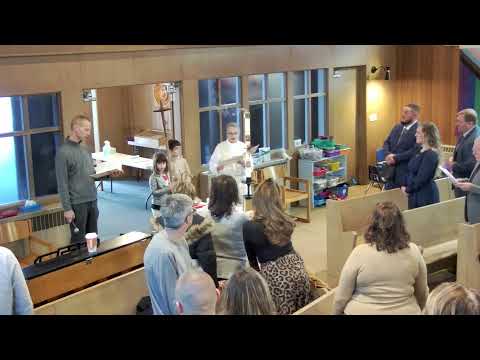
There’s more good news – we have been given a passport in this holy kingdom. In our baptisms, we have been rescued from darkness, into the light of King Jesus. We have been given redemption – our sins are forgiven. Later this morning, Little Jack, too, becomes a passport holder in this kingdom of welcome, wholeness, and promise. Today Jack becomes God’s child, a sibling of Jesus, a fellow, with us, in the Kingdom.
Christ the King Sunday is not an ancient festival of the church. It was instituted by Pope Pius XI 100 years ago, in 1925, “to celebrate the kingship of Christ as a way of combating the destructive forces of this age.” (PT, B, 474). I can somehow imagine the Pope struggling with the rise of modern weapons, or with the 15 to 22 million deaths of World War I and the Spanish Flu. Perhaps he was worried by new ideologies like communism and fascism, by anti-immigrant hysteria, the conflict between religious fundamentalists and modernists, or the massive greed fueling the 1920’s economic system. He might have thought, the world needs to know Christ is King. That we humans are called to something different: not destroying lives . . . but giving life . . . giving our lives.
If the world needed a reminder of Christ the King in the 1920’s, I’m suggesting we need the image of Christ the King now, in 2025. Our culture is dominated and divided by “othering,” blame, retribution, anger, violence, disparity, finger-pointing, and warfare. Take a look at Gaza – where real people used to live, and are still trying to live – the place is annihilated. Think about Charlotte, NC, where the Border Patrol is engaging with, to quote an administration official, “violent criminal aliens” (WaPost, 11/14/25, A10), car windows are smashed, and people spread-eagle on the ground. Consider transgender people, who struggle with who they are, and the uproar about passports matching the sex on their birth certificates. These are not the ways of Christ the King.
Christ the King, today, is a wake-up call. We have to ask the question: what does it mean for us to follow “Christ the King?” What does it mean when we pray every Sunday, “your kingdom come, on earth and in heaven”? What does it mean that our new congregational mission statement proclaims, “God calls us to follow the example of Jesus, acting boldly to build community with diverse people and to nurture creation”?
This past summer, the Transition Team pondered this very question. In creating Holy Trinity’s new mission statement, the transition team asked itself, what does it mean to say we follow Jesus? The team actually made a list of what Jesus did, to try to arrive at an answer.
I’m betting we will continue to debate this question here at Holy Trinity – now and when our new pastor arrives. Christ the King Sunday, is about Christ, after all, but as commentator Gail Ramshaw points out, “The focus is not only on a king who effects all that is good, but also on us who bear the royal seal of baptism.” (Treasures Old and New, 253)
What does it mean to be baptized into the King? To follow King Jesus? In his very first sermon to the people in Nazareth, Jesus said:
The Spirit of the Lord is upon me,
Because he has anointed me to bring good news to the poor.
He has sent me to proclaim release to the captives.
And recovery of sight to the blind,
To let the oppressed go free,
To proclaim the year of the Lord’s favor. (Luke 4:18-19, 21)
Then, aren’t we called to do exactly the same – to spread the good news: release, healing, recovery, and freedom? Surely this is what we, baptized in Christ, are engaged to do? Can we, the baptized, do otherwise?
The U.S. Conference of Catholic Bishops recently taken bold action, making what was described as a “rare group statement,” and I quote, “to condemn the . . . administration’s crackdown on undocumented immigrants as an attack on ‘God-given human dignity,’ and advocated for ‘meaningful reform of our nation’s immigration laws.’” The Bishops “‘oppose the indiscriminate mass deportation of people. We pray for an end to dehumanizing rhetoric and violence, whether directed at immigrants or at law enforcement.’” The statement included examples of suffering experienced by many undocumented, “including ‘arbitrarily’ losing their legal status, being subject to poor detention conditions, and being afraid to take children to school or go to church.” The Bishops voted an overwhelming 216 to 5, with 3 abstentions. (WaPost, 11/14/25, A10)
Aren’t we called to speak out in this bold way? Might we continue to feed those who are teased with cuts in basic food benefits – reportedly 1 out of 8 people in this country, to say nothing of those who do not qualify for federal food assistance. Are we called to advocate to restore lifegiving overseas food, medical, and educational relief formerly distributed by USAID? May we ally with those who are sick with diseases now on the research chopping block, or those who are forced to forego basic medical insurance? Might we gather those who are hurt or exiled by society and many churches because their sexual orientation is different?
Which reminds me, I want to point out that you did something to usher in the reign of Christ just this past week. You came to church, not for a Sunday Service, but to bear witness that King Jesus seeks out and is an ally to those on the margins, in this case trans people. Your coming out on a Thursday night, sitting in these pews, making cookies for a welcoming reception – all of it was testimony to Christ the King who hates lines and division, who instead gathers together.
If you’ll bear with me, I’ll share a story of my own. Two years ago, when we traveled to D.C. for my husband’s funeral, my rental car was stolen at a Metro station. Let Marley tell you what it’s like to ride back to the hotel on the unupholstered back seat of a police car – he was with me when this all took place. This was a stressor I didn’t need at a stressful time. It was really stressful when I learned, months later, that the rental had been totaled and I was responsible for the car’s replacement value, not to mention the offender’s $530 District of Columbia speeding ticket.
Recently I wrote a victim impact statement for the sentencing of one of the young men involved in that theft and in other crimes committed the same evening. I also appeared at his sentencing hearing via Zoom, which took place in federal district court in D.C. This young man was the oldest of 7 children, son of a father who died of an overdose and a mother who has faced abuse charges. He had no high school diploma, and the story went on. All I could think about, at the hearing, was the disparity between his life and my own, the differences in equality, opportunity, education. I had to wonder, just who was the victim here?
Since that hearing I’ve found myself asking this question, “What is my role?” What is Christ calling me to do? I’ve been thinking a lot about this. Maybe you, baptized siblings in King Jesus, have some answers for me.
On this Christ the King Sunday, Jesus ushered in a reign of reconciliation, love, forgiveness, and inclusion, not for the by and by, not someday in heaven, but right now. Jesus, crucified and risen, has already won the battle, and we catch glimpses of his kingdom appearing all over the place, when we see dark places turn to light.
We, the baptized, are called to exactly this – to turn darkness to light, to bring healing and plenty and inclusion to all people and to all of God’s varied, many-faceted creation.
The writer of Colossians prays, “May [we] be made strong with all the strength that comes from his glorious power.” Confident in this power and promise, may we be fearless in walking in the shoes of Jesus, for we are reminded by the 14th century English mystic Julian of Norwich, of the ultimate and already-decided outcome: “All shall be well, and all shall be well, and all manner of thing shall be well.”
For Christ is our King. Amen.